
The Romance of War
And the Ugliness Beneath It

Tachat ha-Shemesh – Under the Sun
Weekly Torah Insights from Miami

What does a young man imagine will happen when he goes to war? The opening verses of Parshat Kitaytzay sum it up:
כִּי־תֵצֵא לַמִּלְחָמָה עַל־אֹיְבֶיךָ וּנְתָנוֹ יְהוָֹה אֱלֹהֶיךָ בְּיָדֶךָ וְשָׁבִיתָ שִׁבְיוֹ: וְרָאִיתָ בַּשִּׁבְיָה אֵשֶׁת יְפַת־תֹּאַר וְחָשַׁקְתָּ בָהּ וְלָקַחְתָּ לְךָ לְאִשָּׁה
When you go to war against your enemies and the Holy One your God delivers them into your hands and you take captives, if you notice among the captives a beautiful woman and are attracted to her, you may take her as your wife (Deut. 21:10-11).
The adrenaline rush of combat is erotic. The swashbuckling hero gets the girl. That’s the P’shat (the narrative). That’s what young men imagine the experience of war to be – in the absence of the experience of war.
Our rabbis sublimate this verse to a deeper level. Most follow the path of Avodat Yisrael, the Torah teachings of the Maggid of Kozhnitz, Israel Hopstein, c.1750 – c.1810.
כי תצא למלחמה על אויביך. הוא הרמז שאמרנו כי עיקר המלחמה נאמר על ר"ה דהוא יומא דדינא וצריך להעריך קרב ומלחמה עם היצ"הר ומארי דדינין: ועיקר המלחמה הוא ע"י התשובה שהאדם משים על לבו לשוב לה' או מיראתו או מאהבתו
When you go to war against your enemies… These words hint concerning what we have said concerning the essence of war – especially now that Rosh Hashanah is near, a day of judgment when one needs to assess encounters and warfare with the yeter ha-ra (the evil inclination) and such harsh antagonists. The nature of war is the process of teshuvah (repentance) that a person engages within one’s heart to return to the Holy One, whether through fear or love……
These words are also written in the absence of the experience of war. Jews of the Ukraine and Poland during the Hasidic period did not go to their rabbis at a time of war to inquire if they should enlist to protect their country. They were not considered citizens. Nor would they be welcomed into the military. After Jewish emancipation in the early 19th century, Jews began to serve. It is conceivable then that a young man might consult a rabbi with such a question.
This matter is more than of passing interest to me, more personal than academic. It is why I began my religious studies. In 1969 when I determined to travel to Israel to learn, I was a veteran of the US Navy, a former destroyer combat intelligence officer with two tours of duty in the Gulf of Tonkin. After months on station, I became conscious of subtle discomfort. I wrote to my rabbi back in Boston. He suggested getting out of there as soon as possible. My request for a transfer was granted.
I then served in a similar capacity on a destroyer south of Cyprus during the Six Day War. That inclined me to search for clarification. One war seemed necessary, the other not. When, if ever, was war appropriate?
Maimonides (1135 – 1204) answers according to Jewish law in his Mishneh Torah, Laws of Kings and Wars.
Maimonides distinguishes between milchemet mitzvah (commanded wars, like defending the nation or fighting Amalek) and milchemet reshut (optional wars, often for territorial expansion or strategic benefit).
Before attacking, the king must offer peace and allow escape routes from besieged cities. If peace is refused, war may proceed.
All warfare must be conducted “for the sake of Heaven”, not for personal gain or vengeance. The king is expected to embody justice and humility.
That’s the essence of what Maimonides presents. It resolved some intellectual difficulties for me at that time.
Years later a Torah teaching I overheard in passing penetrated deeply. I don’t recall who was speaking to whom, where or when it was said, but this is what I remember: One rabbi said to another, “That reminds me of Benno Jacob and his teaching concerning kofer nafsho (the half-sheckel offering collected before a man goes off to war).” Kofer nafsho is often understood as a ransom or atonement for one’s soul should one fall in battle without the opportunity for teshuvah. The rabbi continued, “Benno Jacob considered the kofer nafsho to be an atonement for the soul of the enemy one might be forced to kill in battle.”
Benno Jacob (7 September 1862 – 24 January 1945) was a European-born liberal rabbi and Bible scholar who died in London. He was considered among the great Jewish biblical scholars of the twentieth century. He must have been commenting on Ex. 30:11, 12: Then the Lord said to Moses, “When you take a muster of the Israelites to count them, each one must pay the Lord a ransom for his soul (his life) at the time he is counted.”
Is it possible that when one takes the life of an enemy, even in combat, one acquires guilt for which one must atone? If that is so for a combatant, how much the more so for civilian collateral damage? The word of Torah I overheard in passing provided me insight into the subliminal discomfort that inclined me to transfer away from North Vietnamese waters.
I revisited this in an intense fashion some months ago. At a social gathering I encountered a young man who had recently been commissioned an officer in the Navy. I wished him well and asked him what he aspired to do in his Navy career. He said he hoped to be accepted into flight school. He wanted to fly the F-35 Lightning. I said, the F-35 of today is like the F-4 Phantom in my day. He asked if I had been a pilot? No. I was an air controller responsible for protecting my F-4s as they returned from combat over North Vietnam and getting them safely back to their carriers.
I shared with him that both the F-4 and F-35 are fighter bombers, that their missions might more likely be dropping bombs on enemies they could not see rather than engaging in Top Gun dog fights featured in movie clips. The air operation over North Vietnam,1965-1968, was called Rolling Thunder. It is estimated that Rolling Thunder slaughtered between 30,000 and 150,000 civilians. That also didn’t bother him. The image of sitting at the controls of an F-35 was all that mattered. He was enamored by the romance of the sky.
What about me? I also joined the Navy for romantic reasons, just before the Gulf of Tonkin incident. I was a recent graduate in English and had two job interviews, one with the J. Walter Thompson advertising agency, and one with the U.S. Navy. I aspired to writing the next great American novel. My favorite authors and fictional heroes had all been to sea. The romance of the sea prevailed over the ad agency. The thought of being immersed in a war never entered my mind.
The photo below was published in 1972 when I was already engaged in my rabbinic studies. Had I seen an image like that prior to enlisting, could I have imagined that would ever have anything to do even remotely with me? But it does so now, a great many years later. The Maggid of Kozhnitz is right. This is the season to go to war against the yetzer ha-ra, to search through one’s past and bring to the surface any trace of guilt, no matter how deeply buried, and atone.
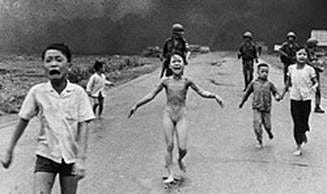
The Terror of War, June 8, 1972: Kim Phúc, center, running down a road naked near Trảng Bàng after a napalm attack.
…….
Subscriptions to these d’vrai Torah are free. Any funds received through pledges benefit the National Havurah Committee.
The Winter Retreat is back! Save the weekend of December 19-21, 2025 for this retreat at Camp Ramah in Palmer, MA.
The National Havurah Committee (NHC) is a network of diverse individuals and communities dedicated to Jewish living and learning, community building, and tikkun olam (repairing the world). For more than 40 years, the NHC has helped Jews across North America envision a joyful grassroots Judaism. The NHC is nondenominational, multigenerational, egalitarian, and volunteer-run.
Excellent article Mitch. I mustered off the Sherman in Genoa and met Pam hours before you sailed off to the Seven Day War.