
Please Hold
Your Call Is Important

Tachat ha-Shemesh – Under the Sun
Weekly Torah Insights from Miami

What do you do when you’re on hold? Do you bring up a game of solitaire? Or do you open a rabbinic text in Sefaria? Solitaire is lonely. Sefaria provides company.
Last week while on hold I called on the Me’or Einayim (1730-1787), the rebbe of Chernobyl. He was instantly online. This is how he opens his teaching on Vayikra, the third book of the written Torah.
ויקרא אל משה וידבר ה׳ אליו מאוהל מועד וגו׳ ויש להבין שמתחלה סתם ויקרא ולא פירש מי קרא ואחר כך פירש וידבר ה׳ אליו, הנה הענין הוא שהשם יתברך הוציאנו ממצרים ונתן לנו תיכף מצות פסח ומילה ואחר כך קרע לנו את הים ואחר כך הוליכנו במדבר בעמוד ענן יומם ובעמוד אש לילה ואחר כך נתן לנו את התורה ואחר כך צוה לעשות משכן כאמור (שמות כ״ה, ח׳) ועשו לי מקדש ושכנתי בתוכם בתוכו לא נאמר כו׳
He called to Moses… (Lev. 1:1). We should understand from the outset the ambiguity of the word Vayikra – he called. It is not clear who or what called to Moses. And after that it was specified that it was Adonai who called. Adonai spoke to him from the Tent of Meeting.
What happened when Moshe called from the Mishkan, the Tent of Meeting? Moshe was put on hold. The words v’ahar kach /ואחר כך / and after that suggest a hold.
Me’or Einayim goes on to explain there were lots of holds along the way before Moses and the Israelites established an ultimate connection with the Holy One. Me’or Einayim tells us:
Here’s the thing / הנה הענין:
(First) the Blessed Holy One brought us out of Egypt – hotzianu mi’mitzrayim. Then He immediately gave us the commandments concerning Passover and circumcision.
— And after that he split the Red Sea for us.
— And after that he led us through the wilderness with a column of cloud by day and fire by night.
— And after that he gave us the Torah.
— And only after that he commanded - “that they should make me a Mishkan (a sanctuary) so I might dwell within them (Ex. 25:8).” Within them is written. Within it is not written.
The Me’or Einayim brings us forward by stages to the ultimate goal, that we ourselves should become a sanctuary within which the Holy One might dwell. Then the connection between us would remain open.
Frequently the written Torah embeds holds within the script. There are short holds of only a few blank spaces (stumot) and long holds (petichot) extending to the end of a line. You can see them in the illustration below.
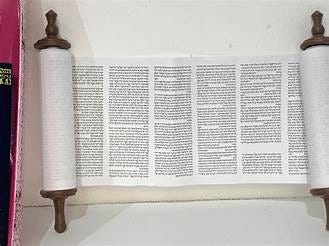
Between the end of the book of Exodus and the beginning of Leviticus are four blank lines, a long, long hold, but they are not empty lines. They are filled not with words but with emotions, intense feelings of apprehension and hope.
Moses has just completed assembling the Mishkan, an elaborate device built according to precise specifications to communicate with the Holy One. Have you ever puzzled your way through complex instructions to assemble a new device? The first time you turn it on, you likely hope beyond hope that you have connected everything properly.
While you wait to see if it works, you have a choice to make. You can either suffer, or you can be patient. The Hebrew words for suffering and patience emanate from the same root – Samech Bet Lamed. To suffer is לסבול / li-sbol. Patience is סַבְלָנוּת / sivlanut. They are the flip sides of the same coin.
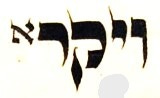
Was Moses suffering, or was he patient? Or did he flip back and forth? He was on hold for one entire blank line. Then a second, and a third, and a fourth before … Vayikra. He heard something. Not much of something, just a little. The word Vayikra / ויקרא is written with a diminutive Aleph, suggesting the Holy One began with a whisper so as not to overwhelm him.
It’s not just when you’re on the phone. You can be on hold in the doctor’s waiting room. There you are referred to as a patient whether you are being patient or not. Or you may be suffering because of resentment that you’ve had to wait so long.
You can be on hold in traffic. With a line of cars stalled ahead of you, there’s nothing you can do. Honking suggests suffering. If you are patient, you can take in your surroundings.
You can be on hold in any line, in any situation in which you are dependent on the movement of others before your goal is achieved. The longer the hold, the more likely patience will flip to suffering. To remain patient some exercise of spiritual discipline is required.
One need not be a rebbe or a Torah scholar to impart spiritual wisdom. The following is a teaching I received many years ago from a travel agent, Marshall Harris (z”l). He had prepared the itinerary for our vacation in Europe.
I realize now he wasn’t so much a travel agent as a travel angel. In the spiritual realm agent and angel are much the same thing. When you shout AGENT into the phone, you’re really asking for an ANGEL.
This is what Marshall shared with us:
“There are many wonderful restaurants in Florence. The best one doesn’t take reservations. There’s always a long line. And when you finally get in, it’s family seating at community tables.
“The food is superb, but only if it’s not flavored with resentment because you had to wait so long in line. So, here’s what you do.
“The line will already be long no matter what time you get there. While Walli holds your place, go around the corner. You’ll find a little wine shop. They’ll have bottles on ice. Have them uncork one for you and ask for a stack of paper cups.
“When you return to your place in line, pass cups forward and backward too, because there will already be a lot of people waiting behind you.
“Pour the wine. Enjoy the company. The wait will still be long, but it will not seem long enough.
“When you are finally seated, it will be with friends, not strangers.”
This a simple but profound teaching in quantum kabbalah. One can consider oneself a particle or a participant. As a particle one chafes in line against the other particles. As a participant, one becomes one with the wave.
Now, here’s a synchronous happening. Just as I was writing the first draft of this Substack, I received a message from the library that a book I had on hold has arrived. I had been waiting for it patiently.
The NHC Summer Institute 2025 will take place Monday, July 28th - Sunday, August 3rd at the Pearlstone Retreat Center in Reisterstown, Maryland. I hope to see you in person this summer.
The National Havurah Committee (NHC) is a network of diverse individuals and communities dedicated to Jewish living and learning, community building, and tikkun olam (repairing the world). For more than 40 years, the NHC has helped Jews across North America envision a joyful grassroots Judaism. The NHC is nondenominational, multigenerational, egalitarian, and volunteer-run.
Todah rabbah, Reb Mitchell. Always learn something from you!
כל הכבוד!
תודה רבה. 💙